China Top 10 Boys Tracksuit Manufacturers
China remains a major sourcing base for children’s sportswear, supported by dense textile clusters, skilled sewing teams, and mature export infrastructure. The World Trade Organization’s World Trade Statistical Review consistently ranks China among the world’s leading textile and clothing exporters. This position gives buyers access to fabric mills, trim suppliers, printing workshops, and finished-garment factories within practical shipping networks.
Market demand is also expanding. Grand View Research valued the global sports apparel market at approximately USD 248.8 billion in 2023. Its report forecasts continued growth through 2030, driven by active lifestyles, school sports, and casual athletic clothing. Boys Tracksuits fit this shift closely. Parents want flexible garments for training, travel, school activities, and everyday wear. Buyers still expect soft fabrics, secure zippers, accurate sizing, and durable color after repeated washing.
This guide introduces ten China-based manufacturers worth examining. The selection considers product experience, production capacity, fabric options, quality systems, customization support, and export communication. Factory evidence matters. Look for sampling records, inspection procedures, relevant test reports, and clear production timelines. Certifications such as ISO 9001 or OEKO-TEX evidence can strengthen confidence, but they should not replace independent verification.
Details reveal more than polished websites. A useful sample should show clean overlock stitching, even waistband tension, smooth zipper movement, and consistent logo placement. No ranking removes every uncertainty. A supplier may perform well on bulk orders yet struggle with small-batch development. Buyers should compare quotations, audit responses, and pre-production samples before choosing a long-term partner. This article offers a practical starting point, not a substitute for careful due diligence.
What Defines a Quality Boys’ Tracksuit Manufacturer in China
A
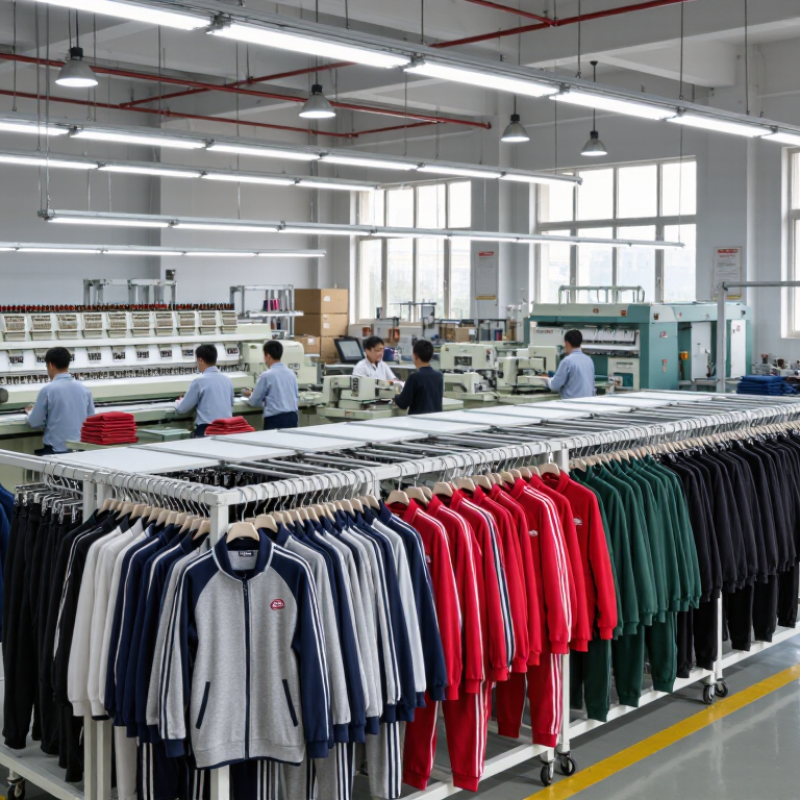
quality boys’ tracksuit manufacturer is measured beyond a polished sample. For a China top-ten shortlist, inspect the workshop, not only the catalog. Technicians should explain fabric weight, shrinkage, pilling, and seam strength clearly. They should provide test records from independent laboratories. ISO 105 colorfastness methods help assess washing and rubbing performance. Still, paperwork alone proves little. Ask for repeated tests on production fabric.
During sampling, a capable team checks ribbed cuffs after repeated stretching. It studies zipper movement on a child-sized jacket. It also measures waistband recovery after washing. These details affect comfort during school runs and football practice. Textile Exchange’s Materials Market Report 2024 recorded 124 million metric tons of global fiber production in 2023. It projects about 160 million metric tons by 2030. This pressure makes recycled content and traceable inputs important. However, recycled claims need transaction records and test evidence.
Reliable factories control more than sewing. They document needle checks, inline inspections, final measurements, and carton humidity. They also manage chemicals carefully and select child-safe trims. A responsible supplier accepts corrections during fitting. No factory is flawless. An honest one reports defects before shipment and explains the fix. Buyers should compare audit dates, sample revisions, lead times, and corrective-action records. A low quotation can hide weak inspection. Sometimes, the cheapest decision becomes the most expensive lesson.
Key Criteria for Comparing China’s Top 10 Manufacturers
China Top 10 Boys Tracksuit Manufacturers
Key Criteria for Comparing China’s Top 10 Manufacturers
Comparing boys’ tracksuit manufacturers requires more than checking factory size or quoted prices. The global sports apparel market reached approximately $248.9 billion in 2023, according to Grand View Research. This growth increases supplier choice, but also makes verification more important. Buyers should review production experience, fabric testing, stitching quality, and children’s sizing accuracy. Ask for recent samples, not only catalog images. Inspect cuff recovery, zipper strength, seam alignment, and print durability after washing.
Technical capability deserves a clear score. Compare fabric composition, moisture management, colorfastness, and shrinkage results. Textile Exchange reported that polyester represented about 57% of global fiber production in 2023. Therefore, manufacturers should explain whether their polyester is virgin or recycled. Certifications such as OEKO-TEX, GRS, ISO 9001, and ISO 14001 can support credibility, but certificates must be checked for validity and scope. Paperwork alone is not enough.
Commercial reliability also separates strong suppliers from average ones. Record minimum order quantities, sample lead times, bulk production schedules, inspection procedures, and response speed. A useful comparison table should assign weighted scores instead of trusting the lowest quotation. Hidden costs often appear later. Ask whether pattern adjustments, packaging, laboratory tests, and replacement pieces are included. Factory audits and third-party inspections provide stronger evidence than promises. Still, no evaluation system is perfect. Communication quality can change during peak seasons, and one successful sample may not represent every production batch.
China’s Top 10 Boys’ Tracksuit Manufacturers
China’s Top 10 Boys’ Tracksuit Manufacturers deserve evaluation beyond factory size. A reliable shortlist should examine fabric testing, stitching accuracy, production capacity, and export experience. Grand View Research estimates the global athleisure market will grow at about 9% annually through 2030. This supports continued demand for practical children’s sportswear.
The leading manufacturers typically offer polyester blends, brushed fleece, moisture control, and reinforced knee panels. These details matter during school sports, travel, and outdoor training. OEKO-TEX testing and ISO 9001 quality systems can strengthen supplier confidence. However, certificates should be checked against current factory documents. A polished website proves little.
Tips: Request a sample before negotiating volume. Measure sleeve length, waistband recovery, seam strength, and colorfastness after washing. Ask for recent audit records and production photos. Compare the actual sample with the approved specification. Small differences become expensive at scale. The China National Textile and Apparel Council continues to emphasize digital production and quality upgrading across textile manufacturing. Yet technology does not replace inspection. I would also review packaging, size grading, and children’s comfort manually. A ranking may look precise, but supplier performance can change between seasons. One manufacturer may excel at fleece sets, while another handles lightweight woven fabrics better. Check the evidence, not only the promised price.
China Top 10 Boys’ Tracksuit Manufacturers
Reference size coverage for boys’ tracksuit production
The chart presents practical body-measurement references commonly used when developing boys’ tracksuits in China, covering height bands from 110 cm to 170 cm. Actual garment measurements may vary according to fit, fabric stretch, pattern design, and production standards.
Product Range, Fabrics, Customization, and Production Capacity
China’s top 10 boys tracksuit manufacturers differ in product range, fabric selection, customization, and production capacity. Most produce school sets, football tracksuits, training suits, hoodies, joggers, and lightweight jackets. Some focus on basic cotton-polyester styles, while others develop technical garments for active children.
Fabric quality needs practical checking. Polyester blends offer durability, quick drying, and easier care. Cotton-rich fabrics feel softer, but they may shrink or dry slowly. For winter tracksuits, brushed fleece adds warmth without excessive weight. Mesh panels can improve airflow during outdoor training. Reliable manufacturers should provide fabric composition, colorfastness results, size charts, and sample approval before bulk production. Small details matter. A weak zipper can damage an otherwise good set.
Customization may include woven labels, heat-transfer graphics, embroidery, piping, reflective strips, and private packaging. Production capacity ranges from small trial orders to large seasonal programs. Ask about minimum order quantities, sample timelines, daily output, inspection procedures, and backup fabric suppliers. A factory with modern equipment is useful, but management consistency matters more. Capacity figures can sound impressive and still fail during peak seasons. That deserves careful questioning.
Tips: Request a physical sample and wash it several times. Check seam strength, waistband recovery, print adhesion, and color changes. Confirm measurement tolerances in writing. Allow extra time for revisions, because the first sample is rarely perfect.
Certifications, Export Services, Pricing, and Supplier Selection
Choosing among China’s top boys’ tracksuit manufacturers requires more than comparing catalog photos. Grand View Research estimates the global sports apparel market will continue expanding through 2030, increasing pressure on factories to prove consistency, not only capacity. Request ISO 9001 records, recent OEKO-TEX Standard 100 test reports, and social compliance evidence. ISO 14001 is useful when environmental controls matter. Check certificate numbers directly with issuing organizations. Documents can be polished. Production can still vary.
Export service should cover fabric testing, size grading, carton labeling, customs paperwork, and agreed Incoterms. Ask for pre-production samples and a final inspection under a defined AQL level. Textile Exchange’s Materials Market Report 2024 reported global fiber production reached about 124 million tonnes in 2023, with polyester remaining the dominant fiber. Therefore, confirm recycled content claims through transaction certificates, not supplier promises. Small details matter: zipper pull strength, knee seam reinforcement, colorfastness after washing, and carton moisture protection.
Pricing needs a transparent FOB or EXW breakdown. Compare fabric weight, trim quality, printing, testing, packaging, and minimum order quantity separately. A cheaper sample may hide weaker elastic or higher defect risk. It happens. A practical supplier scorecard can assign 30% to quality systems, 25% to export execution, 20% to price stability, and 25% to communication and corrective action. Review at least three quotations using identical specifications. One weakness deserves attention: many buyers evaluate the first order, but ignore repeat-order consistency. Ask for defect records, lead-time history, and a written remedy process before signing.